AI

How to Design Complex Prompts for Automated SEO Workflows

Rebeca Gimeno

Just a couple of years ago, the conversation about artificial intelligence applied to SEO revolved around a single question: How do you write a good prompt?
Thousands of tutorials promised better results with a specific phrase, a particular structure, or a set of carefully crafted instructions. For a while, that approach worked. However, as organizations began to incorporate AI into real-world workflows, it became clear that the real challenge wasn’t in creating a spectacular prompt, but in designing systems capable of producing consistent results.
Today, artificial intelligence plays a role in much more than just writing an article. It can help research topics, analyze search intent, generate content clusters, create briefs, optimize text, identify SEO opportunities, and even support editorial review processes. In other words, it no longer performs isolated tasks but is involved in entire workflows.
In this context, an AI prompt is no longer just a simple instruction; it becomes a strategic component within an automated workflow. Its purpose is no longer merely to elicit a response, but to ensure that every stage of the process aligns with the business objectives, SEO strategy, and quality standards defined by the brand.
That’s why the conversation is shifting. Rather than asking ourselves how to write better prompts, it’s worth understanding how to design them so they become part of truly scalable SEO processes.
Thousands of tutorials promised better results with a specific phrase, a particular structure, or a set of carefully crafted instructions. For a while, that approach worked. However, as organizations began to incorporate AI into real-world workflows, it became clear that the real challenge wasn’t in creating a spectacular prompt, but in designing systems capable of producing consistent results.
Today, artificial intelligence plays a role in much more than just writing an article. It can help research topics, analyze search intent, generate content clusters, create briefs, optimize text, identify SEO opportunities, and even support editorial review processes. In other words, it no longer performs isolated tasks but is involved in entire workflows.
In this context, an AI prompt is no longer just a simple instruction; it becomes a strategic component within an automated workflow. Its purpose is no longer merely to elicit a response, but to ensure that every stage of the process aligns with the business objectives, SEO strategy, and quality standards defined by the brand.
That’s why the conversation is shifting. Rather than asking ourselves how to write better prompts, it’s worth understanding how to design them so they become part of truly scalable SEO processes.

What Sets a Simple Prompt Apart from a Workflow Designed for SEO
When people talk about prompts, many imagine a single instruction given to an AI tool. Something like: “Write an article about SEO” or “Generate a description for this product.”
Requests like that may yield acceptable results, but they are unlikely to meet the needs of a professional content strategy.
In an automated workflow, each prompt has a specific role within a broader process. It not only specifies what to do, but also why to do it, who the content is intended for, and what criteria must be met before moving on to the next stage.
For example, before writing an article, an organization can use an initial prompt to identify the predominant search intent, another to analyze competitors, a third to generate an editorial structure, and finally one more to develop the content according to specific guidelines regarding tone, depth, and SEO optimization.
Each step depends on the one before it. If the initial research is inadequate, the rest of the workflow will be as well. Similarly, if the prompt used to generate the content does not provide enough context, the AI will tend to produce generic responses, even if the tool is technically very advanced.
The difference between a standalone prompt and a well-designed workflow lies not only in the complexity of the instructions. It lies in the ability to connect each step so that information flows logically and maintains a strategic direction.
In SEO, that difference can translate into more consistent content, more efficient processes, and a significant reduction in the time spent on subsequent corrections.
How to Structure AI Prompts to Produce Consistent Results
One of the biggest mistakes when automating SEO processes with artificial intelligence is to evaluate a prompt based on a single successful result.
In reality, the challenge begins when that same prompt must be used dozens or even hundreds of times to produce content of a consistently high quality.
That’s why complex prompts don’t rely solely on detailed instructions. They also need to provide enough context for the AI to understand its role within the workflow.
A well-structured prompt typically answers questions that go far beyond the content it is intended to generate. It defines who the audience is, what the purpose of the text is, what tone should be used, what aspects cannot be omitted, and how that task relates to the previous stages of the process.
Let’s imagine a company that needs to create hundreds of product listings for an e-commerce site. If each listing is based solely on a brief set of instructions, the result will likely be inconsistent: some descriptions will be more detailed, others will repeat information, and several will use completely different styles.
On the other hand, when prompts incorporate editorial guidelines, optimization criteria, reusable variables, and brand context, automation stops producing isolated responses and begins to generate content that aligns with a long-term strategy.
Quality, then, is no longer a matter of chance. It becomes dependent on the system’s design.

Automating SEO doesn’t eliminate strategy—it makes it even more important
There is a misconception that automating processes means reducing human involvement. In practice, something different happens.
The more tasks an organization delegates to artificial intelligence, the more important the strategy that defines how that AI should operate becomes.
Automating content generation, for example, does not eliminate the need to understand search intent, build subject matter authority, or develop a solid editorial architecture. Nor does it replace the judgment needed to decide which topics to prioritize, how to organize a content cluster, or what approach provides true value to the user.
Artificial intelligence can perform tasks extremely quickly, but it still needs clear direction.
That is why the organizations that achieve the best results are not necessarily the ones that use the most tools, but rather those that design processes in which each stage has a defined purpose and where human intervention provides judgment, oversight, and strategic vision.
In this scenario, the work of SEO teams is also evolving. Their value no longer lies solely in optimizing individual pieces of content, but in building systems capable of producing useful, consistent content that is aligned with business objectives.
Automation does not replace strategy. It makes strategy the key differentiator.
From the prompt to the system: the future of automated SEO

Advances in artificial intelligence are changing the way brands produce content, but they are also redefining how brands understand SEO.
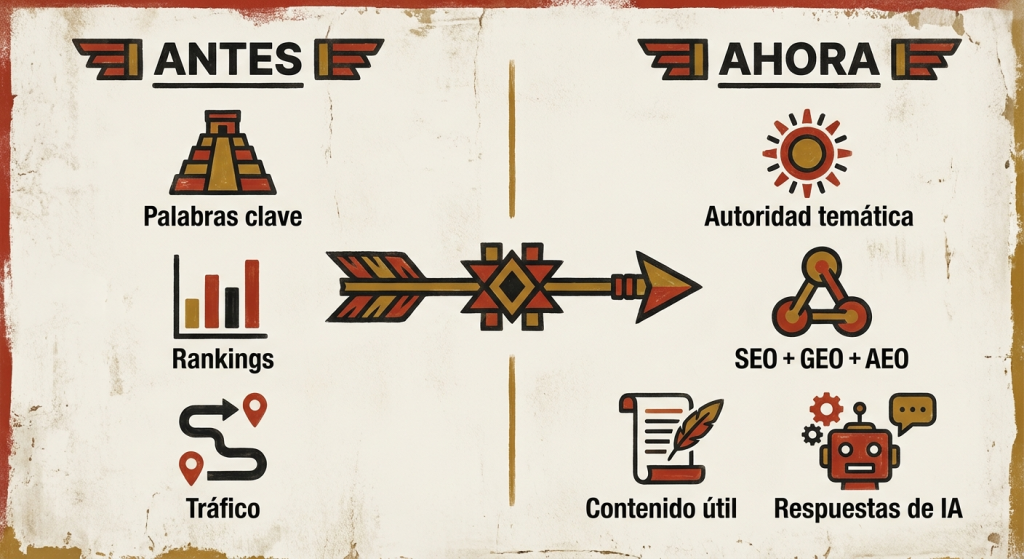
For a long time, it was enough to simply optimize web pages for search engines. Today, it is increasingly important to design processes capable of generating high-quality content in a sustainable manner, while maintaining editorial consistency, thematic depth, and the ability to adapt to a constantly changing digital ecosystem.
In that context, the real asset is no longer a brilliant prompt, but a well-designed workflow.
The organizations that will succeed in scaling their content strategy won’t be those that accumulate the most AI tools, but rather those that manage to integrate people, processes, automation, and specialized knowledge into a single workflow.
Because the future of SEO doesn’t depend on finding the perfect prompt. It depends on building systems that enable the creation of useful content, better respond to users’ needs, and adapt to the constant evolution of search engines and AI-driven experiences.
At Zenit, we help brands design these kinds of systems. We combine SEO strategy, artificial intelligence, and automation to build processes that enable scaling content production without sacrificing quality, consistency, or editorial focus.
Because, in an environment where AI can generate responses in seconds, the true competitive advantage no longer lies in producing more content. It lies in building processes capable of generating the right content, with the right quality, and at the exact moment it truly adds value.
For a long time, it was enough to simply optimize web pages for search engines. Today, it is increasingly important to design processes capable of generating high-quality content in a sustainable manner, while maintaining editorial consistency, thematic depth, and the ability to adapt to a constantly changing digital ecosystem.
In that context, the real asset is no longer a brilliant prompt, but a well-designed workflow.
The organizations that will succeed in scaling their content strategy won’t be those that accumulate the most AI tools, but rather those that manage to integrate people, processes, automation, and specialized knowledge into a single workflow.
Because the future of SEO doesn’t depend on finding the perfect prompt. It depends on building systems that enable the creation of useful content, better respond to users’ needs, and adapt to the constant evolution of search engines and AI-driven experiences.
At Zenit, we help brands design these kinds of systems. We combine SEO strategy, artificial intelligence, and automation to build processes that enable scaling content production without sacrificing quality, consistency, or editorial focus.
Because, in an environment where AI can generate responses in seconds, the true competitive advantage no longer lies in producing more content. It lies in building processes capable of generating the right content, with the right quality, and at the exact moment it truly adds value.