AI

GEO Tools: What They Are and How to Use Them to Improve Visibility in AI

Rebeca Gimeno

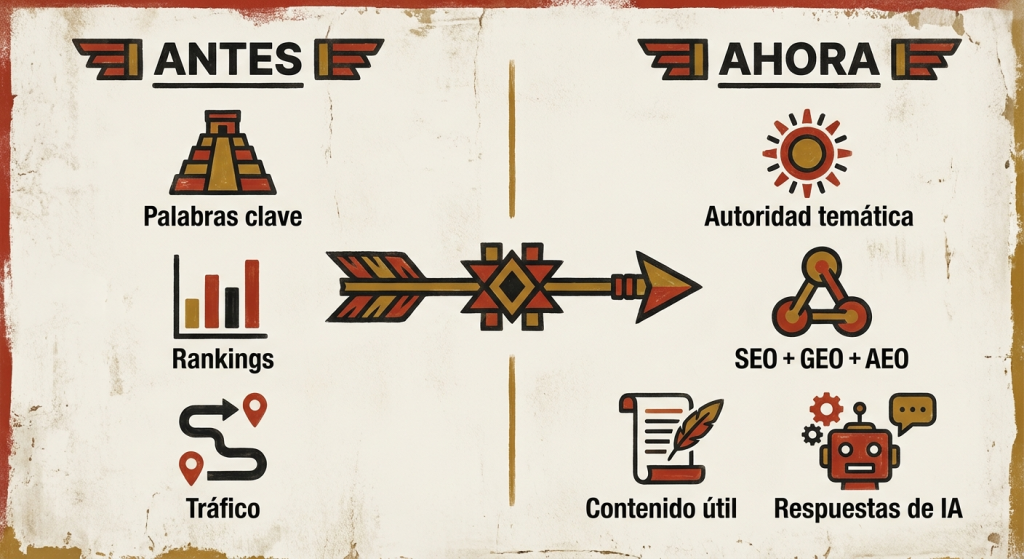
For years, measuring a brand’s visibility on search engines meant tracking rankings, keywords, organic traffic, and clicks. If a page appeared among the top results, it was relatively easy to see that it was gaining visibility.
AI-powered search is changing that logic.
Today, a user can ask ChatGPT, Gemini, or Perplexity which companies offer a particular service, which tools they should consider, or what the best options are within a category—and receive an answer that synthesizes information from different sources.
It’s no longer just about appearing on a results page. It also matters whether a brand is mentioned, in what context it appears, and what information the AI uses to construct that response.
That’s where GEO measurement tools begin to take on greater significance.
These platforms allow you to see how a brand is appearing in different AI-powered search experiences, which competitors have the strongest presence, and which sources are behind the results. But their true value lies not just in displaying data.
It’s about helping to turn that data into strategic questions: Where is our brand? Where isn’t it appearing? Why? And what opportunities exist to strengthen our visibility?
AI-powered search is changing that logic.
Today, a user can ask ChatGPT, Gemini, or Perplexity which companies offer a particular service, which tools they should consider, or what the best options are within a category—and receive an answer that synthesizes information from different sources.
It’s no longer just about appearing on a results page. It also matters whether a brand is mentioned, in what context it appears, and what information the AI uses to construct that response.
That’s where GEO measurement tools begin to take on greater significance.
These platforms allow you to see how a brand is appearing in different AI-powered search experiences, which competitors have the strongest presence, and which sources are behind the results. But their true value lies not just in displaying data.
It’s about helping to turn that data into strategic questions: Where is our brand? Where isn’t it appearing? Why? And what opportunities exist to strengthen our visibility?

What are GEO tools, and what are they used for?
GEO, or Generative Engine Optimization, brings together strategies aimed at improving the visibility of brands and content within generative search experiences.
GEO tools function, in a sense, as observation systems. They allow users to analyze what happens when users make queries related to a brand, product, service, or category on different artificial intelligence platforms.
Instead of focusing on questions like “Where do we rank for this keyword?”, the analysis can address issues such as:
- Does the brand appear in results related to its category?
- How often is it mentioned?
- Which competitors appear alongside her?
- What sources does AI use to generate its responses?
- Which topics generate the most or least engagement?
- How does that visibility change over time?
Some AI visibility platforms include features for monitoring search queries, tracking mentions, analyzing sources, and comparing performance with competitors. However, their capabilities and coverage can vary considerably.
That’s why the goal shouldn’t simply be to find a tool that displays the greatest number of metrics. Before choosing one, you need to understand what information the brand’s strategy actually requires.
A company that is just beginning to explore GEO will have different needs than an organization that already has a well-established content strategy and wants to monitor its presence across multiple categories, markets, or search engines.
And that distinction is important because a tool can provide a lot of data without necessarily providing the answers the business needs.
What a visibility tool for AI should be able to analyze
Measuring a brand’s presence is a good starting point, but it isn’t necessarily enough.
Let’s imagine that a company discovers it appears in some responses related to its industry. At first glance, this might seem like a good sign. However, there are still important questions that need to be answered.
- Does AI present it as a relevant option?
- Does he mention her after several other competitors?
- Do you recommend it for specific use cases?
- What characteristics do you associate with her?
- Do the sources you use come from the brand’s own website or from third parties?
Context can be just as important as the mention itself.
That’s why, when analyzing GEO tools, it’s important to consider different types of signals: presence, context, competition, and sources.
Comparisons with other brands can also reveal interesting information. If a competitor consistently appears in search queries where our brand has little or no presence, this may indicate a difference in authority, topic coverage, or the availability of relevant information.
And sources can offer another perspective. For example, suppose a brand is mentioned in certain responses, but the AI relies primarily on external publications to describe it. This could indicate an opportunity to strengthen the existing information about the brand and the way it develops its areas of expertise. This is where the analysis goes beyond the purely technical.
The data shows what is happening; the strategy must determine what it means and what to do about it.
At Zenit, we understand that this distinction is particularly important. We don’t view measurement tools as a substitute for SEO strategy, but rather as an additional source of information to help us make better decisions about content, authority, and visibility.

What types of GEO tools are there?
The growth of AI-powered search has led to the emergence of various types of platforms designed to measure brand visibility in these environments.
Some focus on monitoring mentions and search queries. Others incorporate competitor analysis, cited sources, changes in online presence, or various AI visibility metrics. Among the tools that have begun to gain traction in this space are platforms such as Profound, Peec AI, and Otterly.
But comparing tools based solely on the number of features can lead to the wrong decision.
The most useful question is a different one: What do we want to know about our presence in AI, and what decisions do we need to make based on that information?
For example, a brand seeking to understand whether it is being considered within its category may need a relatively simple monitoring solution.
An organization with multiple business lines, markets, or target audiences will likely need a much broader analysis capable of identifying differences among topics, search queries, and competitors.
The coverage of the search engines you want to analyze is also important. AI-powered search experiences are evolving rapidly, and not all platforms offer the same capabilities or work with the same environments.
Therefore, before incorporating a tool into a GEO strategy, it’s important to evaluate not only its features but also how relevant its data is to the brand’s specific objectives.
And this is where having expert guidance can make a significant difference: choosing a tool is relatively simple; knowing what to measure, how to interpret the data, and how to integrate it into an existing SEO strategy requires a much broader perspective.
How to Integrate GEO into a Content and SEO Strategy
One of the greatest opportunities offered by GEO tools arises when their data is no longer analyzed in isolation.
Visibility in AI shouldn’t become just another metric that a team checks periodically without connecting it to what they’re doing in SEO and content.
For example, discovering that a brand has little presence in certain search queries may raise questions about the current coverage of topics on its website. Finding that competitors are associated with certain concepts can reveal differences in how each brand builds its authority. And observing which sources are frequently used can provide insights into the information ecosystem surrounding a category.
From there, opportunities may arise in areas such as content, optimization, digital relationships, or building authority.
But there is no one-size-fits-all answer for all brands.
An effective GEO strategy must take into account the industry, the audience, business objectives, the existing level of authority, and the SEO strategy already in place.
Therefore, rather than following a universal checklist, it’s best to view GEO tools as a layer of analysis that complements strategic work.
At Zenit, we work precisely from that perspective: we use available data on search, content, and visibility to identify opportunities and develop strategies that align with how users discover information today.
Because technology provides data. The value lies in knowing what that data means.

The goal isn’t to appear more often—it’s to build a presence that AI can recognize
The emergence of GEO tools does not mean that brands have to abandon SEO in favor of a new metric. On the contrary.
The evolution of generative search is reinforcing principles that were already fundamental to building organic visibility: useful content, subject matter authority, clarity, expertise, and consistency.
What is changing is the way we can observe that visibility.
A brand may have strong organic rankings and, at the same time, discover that it has significant opportunities within generative responses. The opposite can also be true: a brand may have a significant presence in AI but rely on external sources to explain who it is, what it does, or why it should be considered.
None of these scenarios can be understood based on a single metric.
That is why the true value of GEO does not lie in accumulating tools or pursuing a certain number of mentions. It lies in understanding how a brand is being perceived and using that information to strengthen its digital presence.
At Zenit, we help brands navigate this evolution by combining SEO strategy, content, and new AI-driven visibility approaches. We analyze the competitive landscape, identify opportunities, and develop strategies aimed at building a stronger presence in both search engines and new generative experiences.
Because in an ecosystem where artificial intelligence can answer a question in seconds, the most important question for a brand is, “What information is AI using to talk about us, and what can we do to become a point of reference?”
That’s where a GEO strategy that truly adds value begins, and we can help you with that.