
AI

How to Optimize Existing Content with AI: Prompts for Rewriting and Improving Your SEO

Rebeca Gimeno
For most websites, the real potential lies not in what hasn’t been published yet, but in what already exists: articles that once performed well, pages that continue to receive traffic without converting, or valuable content that has simply fallen out of step with how information is searched for and consumed today.
In this scenario, artificial intelligence has become a key tool for optimizing existing content more efficiently. Not to mass-produce text or replace editorial judgment, but to improve clarity, focus, depth, and alignment with current search intent.
Using AI to rewrite content is not about delegating strategy. It’s about accelerating processes without losing control or judgment. The difference between an inefficient result and a truly useful one lies not in the tool, but in how it’s used. And that’s where prompts come in.
A good prompt for improving content not only indicates what to do, but also from what perspective to do it: with what objective, for whom, under what quality criteria, and within what SEO context.
When crafted correctly, prompts can transform flat or outdated content into clearer, more relevant, and more competitive pieces. But to achieve this, it’s essential to first understand the true role of AI within the editorial process.
In this scenario, artificial intelligence has become a key tool for optimizing existing content more efficiently. Not to mass-produce text or replace editorial judgment, but to improve clarity, focus, depth, and alignment with current search intent.
Using AI to rewrite content is not about delegating strategy. It’s about accelerating processes without losing control or judgment. The difference between an inefficient result and a truly useful one lies not in the tool, but in how it’s used. And that’s where prompts come in.
A good prompt for improving content not only indicates what to do, but also from what perspective to do it: with what objective, for whom, under what quality criteria, and within what SEO context.
When crafted correctly, prompts can transform flat or outdated content into clearer, more relevant, and more competitive pieces. But to achieve this, it’s essential to first understand the true role of AI within the editorial process.

What AI Can and Cannot Do When Rewriting Content
Before diving into specific prompts, it’s crucial to understand the true role of AI in content rewriting. It’s not about what it “can do,” but rather how and to what extent you can use it without losing editorial control.
AI is especially useful for optimizing what already exists: improving clarity, reorganizing ideas, adjusting tone, or identifying SEO opportunities. It can also help you see your content through fresh eyes, pointing out redundancies, lack of focus, or sections that don’t add value.
However, AI doesn’t think strategically for you. It doesn’t define business objectives, doesn’t prioritize based on real impact, and can’t guarantee accuracy or depth without clear guidance. Nor does it replace editorial judgment or industry knowledge: it only amplifies them, if you provide them.
That’s why simply asking it to “rewrite this article” usually results in correct but generic text. The real value emerges when AI is given context, intent, and clear criteria. And that context doesn’t start with the prompt, but much earlier: in your analysis of the content, your goals, and what you truly want to improve.

Before Using AI to Rewrite Content: How to Prepare Your Texts
Optimizing content with AI doesn’t start with writing a prompt. It starts much earlier, when you decide what role that content plays today and what it should do better. Without that prior clarity, AI doesn’t optimize—it just rewrites.
Before touching a single line, it’s wise to pause and analyze the piece’s current state: Why does this content exist now? Is it serving an informational, positioning, or conversion function? Does it address the correct search intent, or is it stuck in an outdated version of the topic?
This exercise helps distinguish between what still has value and what no longer contributes. Often the problem isn’t the text itself, but rather that the content has lost focus, depth, or alignment with current objectives.
When you review an article with this perspective, clear patterns often emerge: ideas that repeat themselves without adding anything new, sections that don’t directly address what the user is looking for, confusing structures that make reading difficult, or key topics covered only superficially. Identifying these issues is what allows you to decide how to optimize, not just what to change.
Only after this analysis does AI become truly useful. The clearer you are about what you want to improve and why, the more precise and actionable its responses will be. So, preparing your content before using AI isn’t an extra step—it’s what makes the difference between a generic rewrite and real strategic optimization.
Types of content optimization you can do with AI
The true value of AI becomes apparent when you use it with a clear objective, aligned with the actual state of the content and what you need to improve. Not all texts have the same issues, which is why they shouldn’t all be optimized in the same way.
In some cases, the problem lies in clarity and structure. The content is dense, long, or hard to scan—the information is there, but it’s difficult to read. Here, AI can help you simplify sentences, reorganize ideas, and give the text a more fluid flow without changing the substance.
In other cases, the content is well-written but no longer matches current search intent. What users expect to find today doesn’t always match what they were looking for when the article was published. In this scenario, AI is useful for adjusting the focus, reordering priorities, and reinforcing the answers that really matter.
There are also optimizations clearly geared toward on-page SEO. It’s not about “stuffing keywords,” but rather integrating them naturally, improving headings, reinforcing semantic signals, and aligning the content with how search engines interpret the topic.
Some pieces require more depth and broader coverage. These are typically articles that fell short compared to more comprehensive competitors or that don’t sufficiently expand on key points. Here, AI can help you expand sections, identify gaps in information, and enrich the content without losing coherence.
Finally, there’s the matter of updating older content. Articles that worked well at the time but now need to be adapted to new contexts, changes in the industry, or evolving search behavior. In these cases, AI allows you to update the text without having to rewrite it from scratch.
Identifying what type of optimization each piece needs is what makes AI a strategic tool rather than a simple rewriter. Once this is defined, the next step is knowing how to ask it to do so clearly and effectively.

Examples of prompts for rewriting and optimizing content with AI
Only after you’ve determined what kind of optimization each piece needs does it make sense to write a prompt. Not because the prompt is complex, but because its effectiveness depends on the context you provide.
Below are some examples of prompts for optimizing already published content that address specific goals. These aren’t generic instructions, but starting points you can adapt to your industry, tone, and actual needs.
1. Prompt to improve content clarity and flow:
This type of prompt is useful when the content has value but is difficult to read. Long sentences, ideas strung together without breaks, or an excess of technical jargon are often the problem.
- Base prompt: “Rewrite this text to make it clearer and easier to read, while maintaining the original meaning. Simplify long sentences, eliminate repetitions, and improve flow, without changing the professional tone.”
- When to use it: In dense, technical articles or those with readability issues.
2. Prompt for tailoring content to an informational search intent:
The goal here isn’t to write better, but to provide a better answer. The content may rank well, but it doesn’t fully meet the user’s expectations.
- Base prompt: “Rewrite this content to better address an informational search intent. Prioritize clarity, straightforward explanations, and a logical structure, avoiding promotional language.”
- When to use it: For content that attracts traffic but fails to retain users or resolve their main query.
3. Prompt for on-page SEO optimization without keyword stuffing:
This approach works when the content is solid but needs to strengthen SEO signals without sacrificing editorial quality.
- Base prompt: “Optimize this text for SEO by naturally integrating primary and secondary keywords. Improve headings and structure without over-optimizing or altering the content’s natural flow.”
- When to use it: In articles that need an SEO boost without becoming unnatural.
4. Prompt to expand the depth and thematic coverage of the content:
Some content doesn’t fail because it’s poorly written, but because it falls short compared to more comprehensive content.
- Base prompt: “Identify parts of the text that could be expanded to cover the topic in greater depth. Suggest improvements or additions while maintaining consistency and focus.”
- When to use it: In articles that no longer rank well in search results due to a lack of depth.
5. Prompt for updating old or evergreen content:
This type of optimization is key for evergreen content that once performed well but has lost relevance.
- Base prompt: “Update this content to make it relevant in the current context. Keep what remains valid and adjust sections that may be outdated, improving examples and focus.”
- When to use it: On old articles that have lost traction over time.
These prompts work best when used with clear criteria and context. Otherwise, the AI will only make superficial changes. In the next section, we’ll look at the most common mistakes when rewriting content with AI and how to avoid them.
Common Mistakes When Using AI to Rewrite Content and How to Integrate It Into Your Workflow
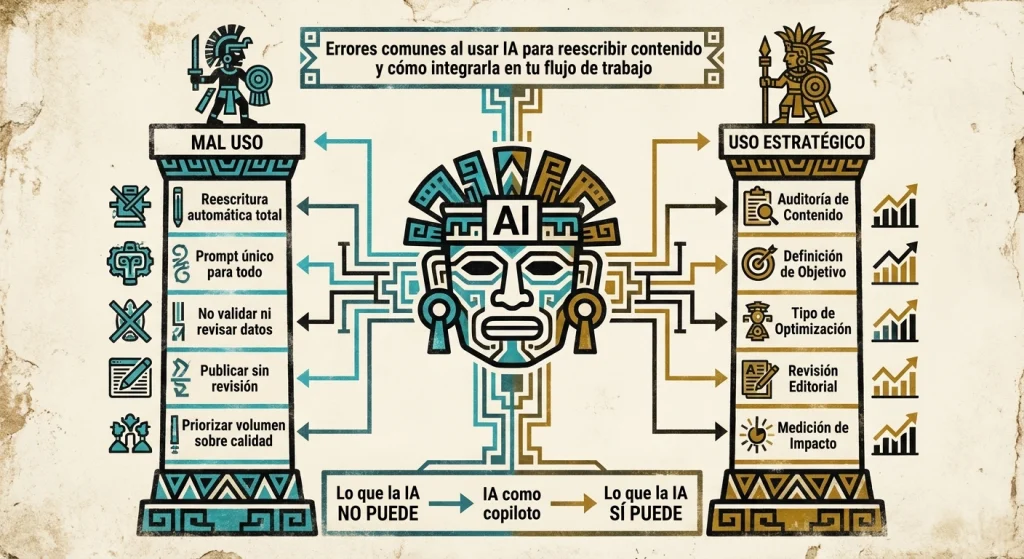
One of the most common mistakes when using AI to rewrite content is treating it as an automatic replacement for editorial work. When used this way, the result is usually predictable: grammatically correct but generic texts, lacking personality or strategic focus.
Rewriting everything indiscriminately, applying the same prompt to pieces with different objectives, or prioritizing volume over quality are signs that AI is being used as a shortcut rather than a support tool. Added to this is a significant risk: failing to verify data, dates, or claims, which can compromise the content’s credibility.
Another common mistake is assuming that the first result is the final one. AI makes suggestions, but it doesn’t validate or decide. If the text isn’t tailored to the brand’s tone, the business context, and the actual objective of the content, the optimization remains superficial.
The difference between misusing AI and using it strategically lies in integrating it into a clear workflow, not in using more prompts.
An effective way to do this is to treat AI as an editorial co-pilot. First, you review your existing content and identify areas for improvement. Then you choose the appropriate type of optimization and use specific prompts tailored to that goal.
From there, you review, refine, and validate the results before publishing, and finally measure their impact to determine next steps.

AI as a Strategic Ally in Content Optimization
Artificial intelligence isn’t meant to replace well-crafted content, but to enhance it. When used with editorial judgment and a strategic approach, it allows us to improve existing content, adapt it to new search intent, and elevate its quality without starting from scratch.
Optimizing content with AI doesn’t mean doing the same thing faster. It means making better decisions: what to keep, what to reinforce, what to update, and what to align with actual business objectives. The difference lies not in the tool, but in the process behind it.
Because in the end, AI can help you write, but relevance, intent, and strategy remain human decisions.
If you want to intelligently integrate AI into your content strategy (without losing focus, quality, or editorial control), at ZENIT we’ll help you do it with method, judgment, and measurable results.
Learn about our services or contact us to take your content to the next level with a clear and sustainable strategy.