AI

Why Conversational Search Is Changing SEO Content

Rebeca Gimeno
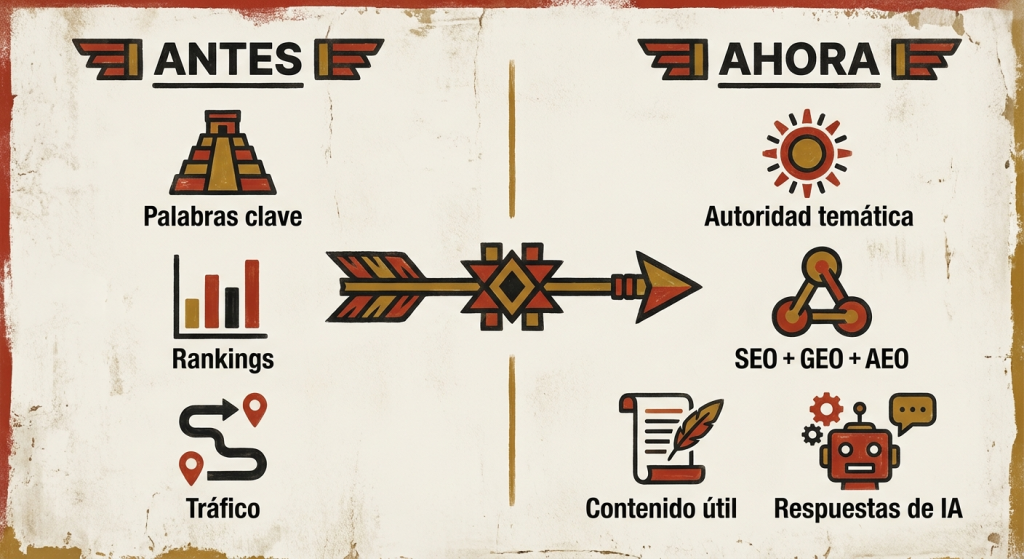
For years, SEO revolved around keywords. Identifying terms, optimizing content, and competing for rankings in search results were at the heart of any strategy. Today, that model is evolving.
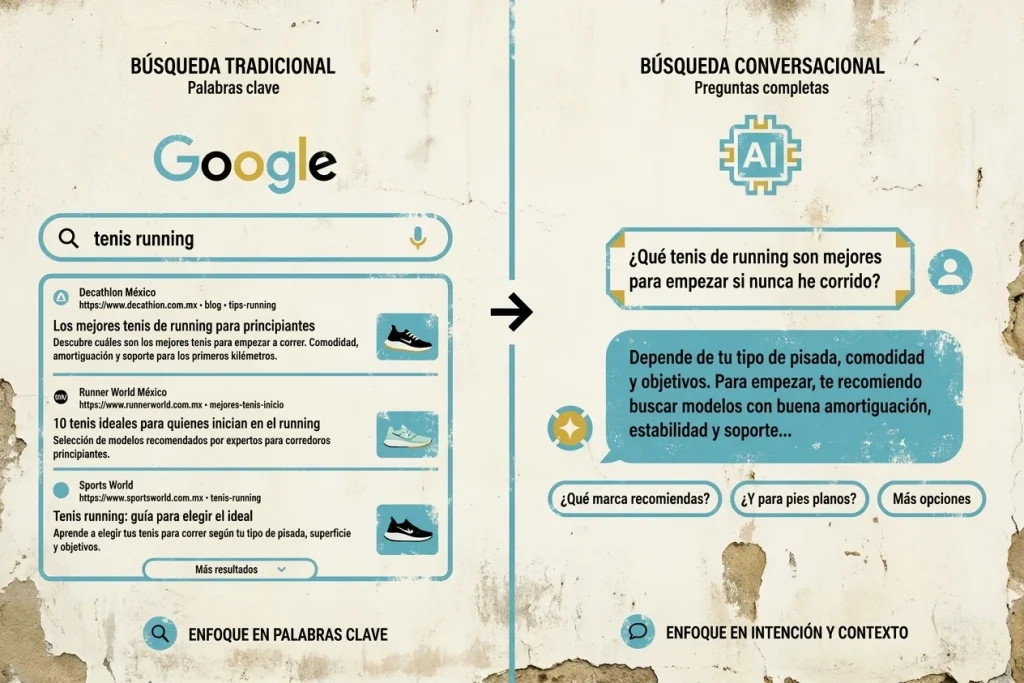
More and more users are no longer just typing in short search terms, but are also typing in complete questions. They do this when using voice assistants, interacting with artificial intelligence tools, or simply searching on their cell phones with more context.
It’s no longer “running shoes.” Now it’s: “Which running shoes are best for a beginner who’s never run before?”
More and more users are no longer just typing in short search terms, but are also typing in complete questions. They do this when using voice assistants, interacting with artificial intelligence tools, or simply searching on their cell phones with more context.
It’s no longer “running shoes.” Now it’s: “Which running shoes are best for a beginner who’s never run before?”
This change is no small matter. It means that content no longer competes solely on the basis of including certain keywords; it now also competes on the basis of providing clear, useful, and contextually relevant answers to a user’s full search intent.
In this new landscape, the content that succeeds isn’t the one that mentions a keyword the most, but the one that best understands the question behind the search and answers it seamlessly.
In this new landscape, the content that succeeds isn’t the one that mentions a keyword the most, but the one that best understands the question behind the search and answers it seamlessly.
What Makes a Conversational Search Different?
To develop an SEO content strategy, you first need to understand what makes this type of search different.
A conversational search is more specific, more contextual, and more demanding in terms of the response.
Users are no longer looking for a general topic, but rather a specific situation. There is a clear intention behind the question, even when it is not fully expressed. And, above all, they expect a direct answer, not an unnecessary detour.
For example:
- Traditional search: digital marketing.
- Conversational Search: How to Develop a Digital Marketing Strategy for a New Brand on a Tight Budget.
In the second case, the content needs to do much more than just explain a concept. It needs to resolve a situation.
Furthermore, these searches are not usually isolated. They are part of a sequence: the user asks a question, gets an answer, and moves on.
This changes the logic behind content. It’s no longer enough to simply cover a topic. Now you have to anticipate what the user will need next.
Content Strategies for Responding to Conversational Searches
Adapting to this type of search isn’t just a matter of making minor adjustments. It means rethinking how content is built from the ground up and designing it as a comprehensive answer.

Answer the questions in full—don’t just use keywords
The starting point now is a real question. This changes the way you conduct research. Instead of focusing solely on search volume, you need to understand how users phrase their questions and what they expect to find.
This means going beyond traditional tools and looking at sources where questions arise naturally:
- Sections such as: “Other Questions from Users”
- Forums
- Conversations with Customers
- Internal searches on your own site
For example, instead of using “AI SEO,” you could start with something like: “How to use artificial intelligence to create SEO content that actually ranks.”
This affects not only the title, but also the structure, level of depth, and focus of the content.
When you start with a real question, the content aligns more naturally with the search intent.
Write the way the user speaks
Conversational searches are based on natural language. However, much content is still written using rigid or unnatural structures.
It’s not about oversimplifying, but about writing clearly, naturally, and precisely. You should avoid awkward sentences, unnecessary jargon, or structures that prioritize the keyword over clarity.
When content sounds natural, it doesn’t just improve the user experience. It also makes it easier for language-based search systems to better understand its relevance.
Create content that anticipates the next question
One of the most important differences with this type of search is that it doesn’t end with a single query. The user continues.
If someone searches for“how to create SEO content with AI,”they’ll likely want to understand the following:
- What tools to use
- What Mistakes to Avoid
- How to Measure Results
Good content doesn’t wait for the user to come back and search again. It guides the user along the same path.
This is achieved by connecting sections, gradually expanding the context, and structuring the content as a logical sequence: if you’ve already understood this, the next step is this.
It can also be reflected in subtitles that serve as a natural continuation of the topic, rather than as isolated blocks.
Prioritize intent over keywords
For a long time, SEO optimization focused solely on strategically incorporating keywords. Today, that’s not enough.
Two searches may share similar terms but address completely different intents: one informational, another comparative, and another decision-oriented.
If the content doesn’t properly address that intent, it will have a hard time competing, even if it’s well optimized in other ways.
Before writing, the key question is: What does the user really need when they perform this search?
Build depth, not just coverage
In an environment where AI facilitates content creation, the difference no longer lies in publishing more, but in publishing better. Superficial content may cover a lot of ground, but it rarely solves anything.
Depth involves developing ideas, providing context, explaining implications, and illustrating concepts with clear examples.
For example, it’s not enough to simply say that“AI helps create SEO content.” You need to explain how it fits into the process, what decisions it requires, and what impact it has on the final result.
Common Mistakes When Creating Content for Conversational Searches
When you try to adapt a strategy without changing your approach, mistakes arise that limit the impact of the content.
One of the most common mistakes is creating content that appears to answer a question but actually doesn’t. It introduces the topic and provides context, but never arrives at a clear or useful answer for the user.
It is also common to use artificial intelligence without a defined strategic direction. This often results in texts that are grammatically correct but generic in substance, offering neither differentiation nor depth.
Another common mistake is continuing to think in terms of isolated keywords, without considering the full context of the search. This fragments the content and makes it difficult for it to truly address the user’s intent.
And finally, there’s superficial content: pieces that touch on many topics but don’t explore any of them in enough depth to provide real value.
In all these cases, the problem isn’t technical. It’s a matter of approach.

How to Start Adapting Your Content Today
Adapting to conversational searches doesn’t mean starting from scratch, but it does mean adjusting the way you approach content.
1/ The first step is to change your approach to research. Instead of focusing solely on keywords, start working with real questions and observe how queries are phrased in different contexts.
2/ The second step is to review your existing content. Often, you don’t need to start from scratch; instead, you can improve what you already have—making it clearer, more useful, or more in-depth.
3/ The third step is to optimize the structure. Well-organized content not only makes it easier to read, but also allows it to better address different levels of intent within a single piece.
4/ And finally, integrate artificial intelligence as a support tool. It can speed up processes, but the value still lies in the strategy that defines how it is used.
The change isn’t technical; it’s strategic
Conversational searches are not just a technological advancement. They reflect how people think, ask questions, and make decisions.
Adapting to this change means gaining a better understanding of the user and moving away from thinking in isolated terms to start thinking in terms of complete conversations.
Because, in the end, the content that wins isn’t just the one that uses keywords best. It’s the one that also eliminates the need to keep searching.
From Optimized Content to Responsive Content
The shift from traditional searches to conversational searches marks a clear change in the way content strategies are developed for SEO.
Today, it’s not enough to simply appear in search results. You need to be relevant in the context of a specific query.
That means designing content that understands the user’s intent, provides useful answers, and supports the user beyond a single query.
That’s where a well-designed strategy makes all the difference.
At Zenit, we help brands transform their content into a strategic asset by combining data, user insights, and results-driven execution.
If you’re looking to adapt your strategy to this new landscape and create content that truly resonates—not just ranks well—we can help you design that process together. Learn more about our services.