AI

GEO Audit: Why Your Brand Doesn’t Appear in AI Responses

Rebeca Gimeno

Digital visibility is changing. For years, brands have worked to appear among the top results on Google, attract organic traffic, and position themselves as leaders in their industry. Today, that effort coexists with a new reality: users who turn to artificial intelligence tools to compare options, research products, or find suppliers without necessarily visiting a traditional search results page.
In this context, ranking highly in search engines does not guarantee that a brand will appear in AI-generated results. A company may have optimized content, a technically sound website, and a well-established digital presence, and yet still be left out of the recommendations a user receives.
Why does this happen? There is no single answer. r generative visibility depends on various factors related to the information available about a brand, the sources used by AI systems, the context of the query, and how they interpret the information. That’s why, before modifying content or implementing new tactics, it’s important to understand what’s happening.
A GEO (Generative Engine Optimization) audit allows you to investigate how a brand appears in AI responses, what information contributes to building that representation, and where there are opportunities for improvement.
At Zenit, we know that improving organic visibility starts with an analysis that links the observed signals to specific decisions regarding SEO, content, and digital authority.

Why Your Brand Doesn’t Appear in AI Responses
Just because a brand doesn’t appear in an AI-generated response doesn’t automatically mean there’s a technical issue or that its SEO strategy has stopped working. Generative AI systems interpret queries and construct their responses based on information that can vary depending on the system, the question, the context, and the available sources.
There are various reasons why a brand might be omitted from these responses. Its value proposition may not be sufficiently differentiated, the available information may be incomplete or out of date, or its content may not clearly address the needs expressed by users. It’s also possible that other brands have a more consistent presence in the sources consulted by AI systems.
These possibilities do not imply that there is a single cause or that they can be confirmed without analyzing each case. Therefore, before modifying the content strategy or implementing new optimization measures, it is important to identify the signals provided by the brand’s digital presence and how they relate to its visibility in generative environments.
Analyzing a brand’s visibility in AI environments requires going beyond simply checking whether or not it appears in the responses. It is necessary to understand how it is represented, what information contributes to that representation, and what opportunities exist to strengthen its presence relative to other alternatives in the industry.
What Does a GEO AI Visibility Audit Analyze?
A GEO audit isn’t just about entering a company’s name into various AI tools and recording whether it appears. That exercise can serve as a starting point, but it offers a limited view if it isn’t linked to business-relevant queries, the context of the responses, and the presence of competitors.
The analysis should begin by defining what it means for the brand to be visible. Not all mentions have the same value: appearing in a response that is only loosely related to the company’s business is not the same as being a recognized option when a user is evaluating solutions in that category.
With that objective in mind, an audit can examine several aspects:
- Presence and context of mentions. In what types of search queries does the brand appear, how is it described, and is it associated with its actual products, services, or areas of expertise?
- Sources and references. Which websites, publications, or other sources are used to construct the responses, and what role does the brand’s own information play within that set.
- Comparison with competitors. Which companies appear in similar search queries, how their value propositions are presented, and what differences are observed in the information available about each one.
Consistency of information. Whether the brand’s messages, attributes, and data are clear and consistent across its website and other relevant sources. - Variation across queries and systems. Whether the brand’s presence changes when the search intent, the phrasing of the question, or the analyzed AI engine is modified.
These factors must be interpreted together. One brand may be mentioned frequently but be associated with the wrong category; another may appear only rarely, but in searches with high commercial value. Similarly, identifying a recurring source does not, in and of itself, prove that it is the cause of a recommendation.
The audit seeks precisely to identify patterns, test hypotheses, and distinguish relevant findings from the variations inherent in generative systems. To draw useful conclusions, the analysis requires representative samples, consistent evaluation criteria, and a strategic interpretation of the results.
What AI visibility issues can a GEO audit detect?
Once visibility has been analyzed, the next step is to interpret the signals. The absence of a brand in AI responses can have various explanations, and in many cases, it will not be possible to attribute it to a single factor.
One possible finding is a content gap. The company may explain clearly what it does, but it may not provide sufficiently in-depth answers to the questions that arise during the evaluation of its solutions.
Another possibility is a value proposition that lacks differentiation. When several companies use similar messaging, it becomes more difficult to build a clear picture of their areas of expertise, advantages, or areas of experience. Reviewing how the brand is described on its own channels and in external sources can help identify contradictions, gaps, or associations that do not reflect its desired positioning.
The audit may also reveal opportunities related to subject matter authority and external presence. If the brand wants to be recognized for a specific area of expertise, it’s worth analyzing whether its content, references, and digital presence send consistent signals about that field. The goal is not to chase mentions indiscriminately, but to understand what information supports its relevance and credibility.
Finally, technical issues or problems with the quality of the information may arise that make it difficult to access, understand, or update certain content. However, it is important not to assume that all visibility issues can be resolved through technical adjustments, nor that publishing more content will automatically generate more mentions.
The value of diagnosis lies in identifying which hypotheses are supported by the data and which require further investigation. Without that distinction, a brand runs the risk of investing resources in changes that do not address the root cause of the problem.

How to Prioritize GEO Optimization Opportunities
Identifying a gap is only part of the job. The impact of a GEO audit depends on whether the results are translated into priorities aligned with business objectives.
Not all opportunities carry the same weight. Improving the information on a key conversion page may be more important than increasing mentions in general search queries. In other cases, the priority will be to correct inconsistent information, strengthen the explanation of a specialty, or review how content on the same topic relates to one another.
To make these decisions, it is helpful to consider three factors: the relevance of the inquiry to the business, the identified gap, and the brand’s ability to address it. This analysis helps distinguish between immediate adjustments and areas of focus that require a broader strategy.
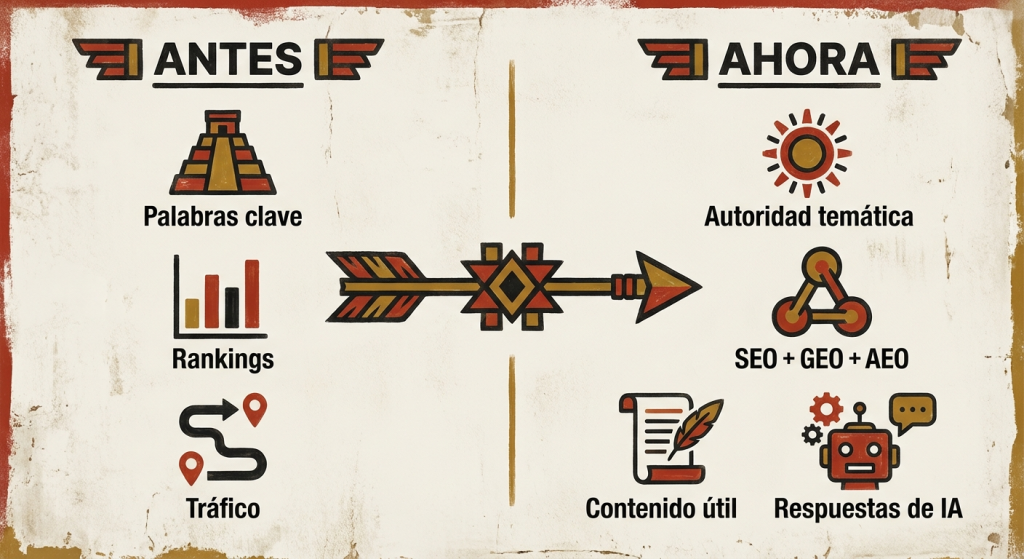
GEO results must also be integrated with traditional SEO. Keyword research, site architecture, content quality, user experience, and digital authority remain important components of an organic strategy. Optimization for generative environments broadens the analysis: in addition to evaluating how pages rank, it’s important to understand how brand information is interpreted and used in AI responses.
Measurement requires the same logic. An improvement should not be evaluated solely based on an increase in mentions, but also on its context, its relationship to relevant search queries, and changes in the brand’s visibility. Since results can vary across systems and over time, it is important to maintain comparable tracking criteria and avoid drawing conclusions based on a single observation.
At Zenit, we approach generative visibility from this perspective: connecting data with real opportunities for optimization and determining which actions deserve priority. The goal is not to accumulate GEO tasks, but to build a strategy that aligns with each company’s positioning, resources, and goals.
From the GEO Audit to an AI Visibility Strategy
Artificial intelligence is introducing new ways to discover, compare, and evaluate brands. In this context, understanding how a company appears in generative responses is becoming increasingly important, but measuring its presence without interpreting the results can provide an incomplete picture.
A customized GEO consulting service helps establish a starting point: identifying the contexts in which the brand appears, how it is represented, which sources are involved in that representation, and which opportunities warrant a more in-depth review. From there, the strategy can incorporate improvements in content, SEO, information consistency, and digital authority, with ongoing monitoring to evaluate its progress.
This does not mean that a brand can control what each AI system will respond with or guarantee that it will be recommended. It means that a brand can make more informed decisions about the quality, clarity, and relevance of the available information, as well as measure how its presence evolves in the environments its audience uses.
At Zenit, we combine generative visibility analysis with GEO consulting to help brands understand their current situation, identify gaps, and turn those findings into an optimization plan.
Because it’s not enough to know if AI mentions your brand—you need to understand the context in which it does so, what opportunities you’re missing, and how to integrate that information into your digital strategy.
If you want to know how your brand is performing in AI-powered search environments and which aspects you should prioritize, a generative visibility audit can be the first step toward making clearer decisions.