AI

How to Create Content That AI Can Interpret, Understand, and Cite

Rebeca Gimeno
For years, the goal of an SEO strategy seemed perfectly defined: to get a page to appear among the top search results. Today, that landscape is beginning to change. More and more people are getting answers directly from tools like ChatGPT, Gemini, Perplexity, or AI-powered search experiences, without having to click through multiple links or compare dozens of pages.
For brands, this poses a new challenge: How can they create content that not only ranks well on Google but can also be interpreted, understood, and considered a reliable source by artificial intelligence systems?
This shift has given rise to concepts such as Generative Engine Optimization (GEO) and Answer Engine Optimization (AEO), which aim to adapt content strategies to an ecosystem where conversational responses are becoming increasingly important. However, behind these new terms lies a much more important idea: the content that works best for artificial intelligence is often the same content that truly adds value for people.
That’s why, rather than asking ourselves how to “position a brand on ChatGPT,” it’s worth understanding what characteristics make content useful, clear, and reliable for any system that needs to organize information and provide high-quality answers.
For brands, this poses a new challenge: How can they create content that not only ranks well on Google but can also be interpreted, understood, and considered a reliable source by artificial intelligence systems?
This shift has given rise to concepts such as Generative Engine Optimization (GEO) and Answer Engine Optimization (AEO), which aim to adapt content strategies to an ecosystem where conversational responses are becoming increasingly important. However, behind these new terms lies a much more important idea: the content that works best for artificial intelligence is often the same content that truly adds value for people.
That’s why, rather than asking ourselves how to “position a brand on ChatGPT,” it’s worth understanding what characteristics make content useful, clear, and reliable for any system that needs to organize information and provide high-quality answers.

AI doesn’t search for pages—it searches for information it can understand and connect
When a person performs a Google search, they typically receive a list of results from which they can choose. A generative search engine, on the other hand, attempts to do something different: interpret the query, identify the most relevant information, and construct a coherent response based on various sources.
That completely changes the logic behind content. It’s no longer enough to simply address a keyword superficially or create multiple pages targeting similar variations of the same query. AI-powered search engines need to understand the full context of a topic, identify relationships between concepts, and recognize which sources provide a clear and consistent explanation.
Let’s consider a company that specializes in marketing automation. If it publishes just one article on “automation,” it will likely have a hard time demonstrating expertise. On the other hand, if it develops content related to workflows, artificial intelligence, CRM, segmentation, lead nurturing, and performance measurement, it begins to build a knowledge ecosystem that makes it easier for both users to understand and for generative models to interpret.
In other words, AI doesn’t just analyze individual pages. It also interprets how content on the same site relates to one another, how comprehensive the coverage of a topic is, and whether a brand consistently demonstrates expertise.
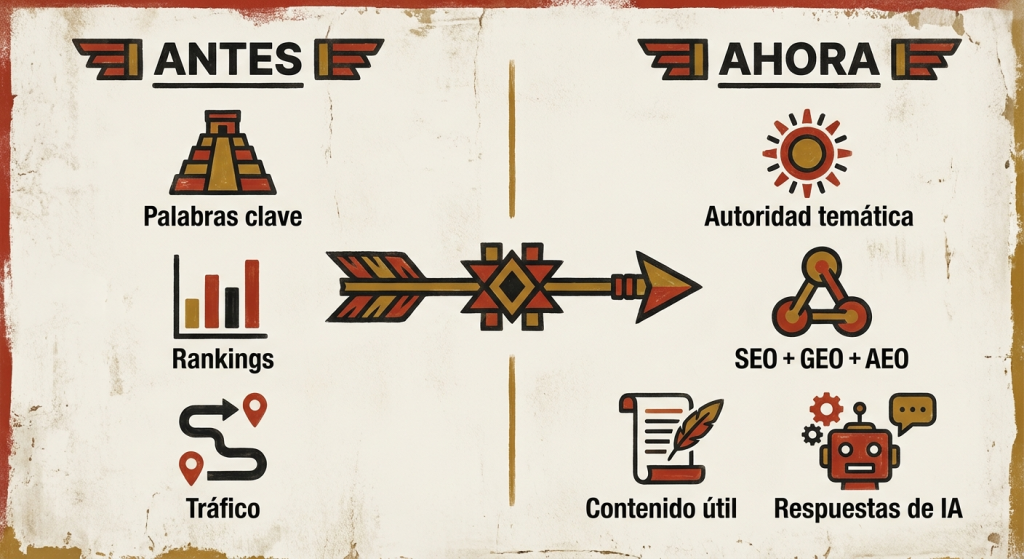
For this reason, building subject-matter authority plays an even more important role in SEO, GEO, and AEO strategies.
What characteristics does content have that can make it a reliable source?
There is no formula that guarantees that a piece of content will be used by an artificial intelligence engine. However, there are common patterns among content that offers greater value to both users and the systems that organize information.
One of them is depth. Content that explores a topic with context, examples, and clear explanations is usually much more useful than content that simply lists concepts or repeats general definitions.
For example, an article that explains what GEO is, how it relates to SEO, in what situations it adds value, and what its limitations are provides much more context than a text that merely defines the term in a couple of paragraphs. That level of depth helps both users and AI systems better understand the topic.
Structure also plays an important role. Descriptive headings, a logical sequence of ideas, and natural language make the content easier to understand and help both people and AI systems quickly identify the answer to a specific need.
Another key aspect is thematic consistency. Publishing a single, high-quality article may generate short-term visibility, but it is unlikely to build authority. In contrast, when a brand develops content that is interconnected, strategically linked, and aimed at addressing different questions within the same topic, it begins to establish a much stronger presence.
This is precisely one of the principles we apply at Zenit. Our content isn’t intended to simply answer a specific search query. It’s part of an editorial strategy in which each article complements the previous ones, delves deeper into a different aspect, and helps establish authority in the areas of SEO, artificial intelligence, and the evolution of search.
This consistency not only benefits organic search rankings on traditional search engines; it also helps generative engines better understand the knowledge a brand has developed.

GEO and AEO: Optimizing Content to Deliver Better Results, Not Just for Search Rankings
The emergence of concepts such as GEO and AEO in SEO has created the impression that brands need to completely reinvent their content strategies. In reality, the change is less radical than it seems.
For years, SEO has promoted best practices such as creating useful content, understanding search intent, structuring information correctly, and building subject matter authority. GEO and AEO are based on those same principles, but apply them to a context where AI-generated responses are playing an increasingly prominent role.
The difference is that now content must not only compete for a position in search results, but also to become a trusted source within AI-generated responses.
That’s why optimizing for generative AI isn’t about writing for an AI. It’s about creating content that’s easy to understand, answers real questions, and provides enough context to serve as a reliable reference.
A clear example is conversational search. Users no longer simply ask, “What is GEO?” They can now ask questions such as, “How do I develop my content strategy to appear in AI-generated answers?” Answering these types of questions requires much more than simply repeating a definition. It requires connecting concepts, providing examples, and offering a comprehensive explanation.
That is precisely the kind of content that both people and generative models are beginning to value more and more.
The future of content will not be about publishing more, but about building knowledge

Artificial intelligence is changing the way we find information, but it is also raising the quality standards that brands need to meet.
In an environment where creating content is becoming increasingly easy, the real challenge is no longer about publishing faster. It’s about building knowledge that adds value, answers complex questions, and remains consistent over time.
This means moving away from strategies focused exclusively on isolated keywords and starting to develop content ecosystems where each post strengthens the brand’s subject-matter authority.
In an environment where anyone can create content in a matter of seconds, the real competitive advantage no longer lies in publishing more. It lies in building knowledge that is worthy of being cited as a reference.
That’s the kind of strategy we develop at Zenit. We combine SEO, GEO, and AEO to help brands create content ecosystems that not only rank well in search engines but can also be understood, interpreted, and utilized by the new AI-powered search experiences.
Because the future of digital visibility won’t depend solely on appearing first on a results page. It will depend on becoming a trusted source when people—and now AI as well—are looking for answers.
If your content strategy is still focused solely on driving clicks, it might be time to evolve. At Zenit, we help brands design content strategies tailored to the new search ecosystem, where SEO, GEO, and AEO work together seamlessly to build authority, relevance, and sustainable growth.