
AI

SEO Retail Media: The New Frontier Between Organic Visibility and Digital Commerce

Rebeca Gimeno
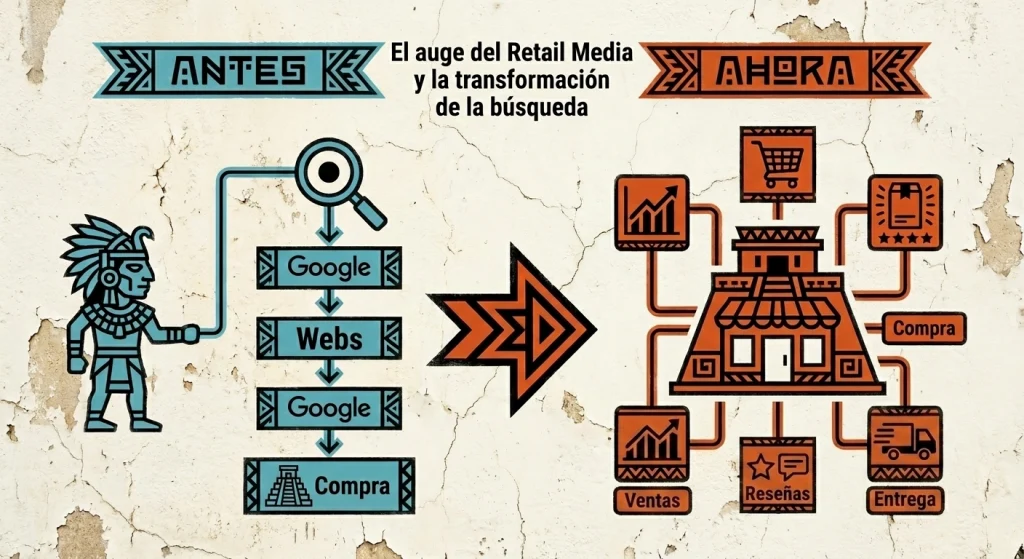
More and more product searches are starting within marketplaces themselves rather than on traditional search engines. For many brands, this means that a growing portion of digital visibility is no longer determined solely by Google, but by the internal algorithms of platforms such as Amazon, Walmart, Mercado Libre, or Instacart.
For years, SEO has been understood as the discipline responsible for improving visibility on search engines. However, the growth of Retail Media is transforming that landscape.
Today, millions of purchasing decisions begin directly within retailers’ ecosystems: marketplaces, online supermarkets, delivery apps, or e-commerce platforms, where searches occur within the platforms themselves.
This shift has given rise to a new strategic territory: Retail Media SEO, a discipline that combines organic optimization, commercial data, and advertising within digital commerce platforms.
Understanding how this ecosystem works is becoming a competitive advantage for brands that sell online. Not only because it determines which products appear first in internal searches, but because it directly influences visibility, discovery, and conversion.
For years, SEO has been understood as the discipline responsible for improving visibility on search engines. However, the growth of Retail Media is transforming that landscape.
Today, millions of purchasing decisions begin directly within retailers’ ecosystems: marketplaces, online supermarkets, delivery apps, or e-commerce platforms, where searches occur within the platforms themselves.
This shift has given rise to a new strategic territory: Retail Media SEO, a discipline that combines organic optimization, commercial data, and advertising within digital commerce platforms.
Understanding how this ecosystem works is becoming a competitive advantage for brands that sell online. Not only because it determines which products appear first in internal searches, but because it directly influences visibility, discovery, and conversion.
The Rise of Retail Media and the Transformation of Search
The growth of Retail Media reflects a profound shift in consumer behavior.
More and more users are starting their shopping journey directly on marketplaces or online stores, rather than on traditional search engines. For many products, the first search takes place within the retailer’s own platform.
This shift has significant implications for digital visibility strategies. When a user searches for a product within a marketplace, the system that determines which results appear first does not function exactly like a traditional search engine. Although there are similarities to classic SEO, the ranking algorithms of these platforms prioritize different signals, such as:
- Product sales performance, which reflects how well it sells compared to similar alternatives.
- Conversion rate, which indicates the product’s ability to convert visits into purchases.
- Inventory availability, as retailers prioritize products that can be delivered quickly.
- Delivery speed, an increasingly decisive factor in the purchase decision.
Reviews and reputation, which influence consumer trust. - Advertising spend on the platform, which can drive initial product discovery.
In this context, visibility no longer depends solely on content or keywords. It is also closely tied to the product’s commercial performance within the retailer’s ecosystem.
That is why understanding how search works in retail has become just as important as understanding traditional SEO.

What is Retail Media SEO and Why It’s Gaining Momentum
In this new landscape, a discipline is emerging that bridges search marketing and e-commerce.
Retail Media SEO sits precisely at the intersection of three areas that previously operated relatively independently:
- Content and keyword optimization.
- Product catalog management.
- Retail Media Ads strategies.
While traditional SEO focuses on ranking web pages in search engines, Retail Media SEO focuses on optimizing product visibility within digital commerce platforms.
This involves working on elements such as:
- Titles and descriptions optimized for internal searches
- Catalog taxonomies and categories
- Product attributes that facilitate filtering and discovery
- Image quality and visual content
- Review and reputation management
- Competitive pricing compared to similar products
- Consistency between advertising spend and organic ranking
On many marketplaces, paid ads and organic results do not operate as completely separate entities. On the contrary: they constantly feed into each other.
A product that achieves strong conversion rates through Retail Media campaigns can improve its organic search rankings. At the same time, effective organic optimization can reduce reliance on advertising spend.
This dynamic makes Retail Media SEO a hybrid discipline, where marketing, e-commerce, and search optimization converge.

How to Optimize Products for Search Within Retailers
Optimizing products within retail platforms requires a different approach than traditional SEO.
Instead of focusing on editorial pages or content articles, the focus is on product listings, which serve as visibility units within the marketplace.
Some of the most important factors include:
Semantic product optimization
Titles, descriptions, and attributes must reflect the way users search for products within the retailer.
This involves researching not only external keywords but also the marketplace’s internal search patterns. In many cases, the terms consumers use within these platforms can differ significantly from those they use in traditional search engines.
For example, on some marketplaces, users tend to search for very specific combinations of attributes such as brand, size, material, or functionality, making the way product titles and attributes are structured particularly important.
Catalog Structure and Categorization
The way a product is categorized directly influences its visibility.
Poor category assignment can limit product discovery, even if content optimization is done correctly. Furthermore, on many marketplaces, navigation filters depend directly on the attributes and categories assigned to the product.
Therefore, the catalog structure becomes a key element in facilitating discovery.
Commercial Performance Signals
Retail algorithms prioritize products that demonstrate strong performance within the platform.
Among the most relevant signals are:
- Conversion Rate
- Sales volume
- Positive reviews
- Inventory availability
These signals help algorithms identify which products generate the highest satisfaction and value for users.
For this reason, Retail Media SEO cannot be approached solely through content. It also requires close coordination with the e-commerce, pricing, logistics, and customer experience teams.
The Convergence of SEO and Retail Media Ads
One of the most interesting aspects of Retail Media SEO is the relationship between organic visibility and advertising within platforms.
Unlike traditional search engines, where SEO and SEM can operate relatively independently, in retail ecosystems there is constant interaction between the two.
Retail Media Ads campaigns can:
- Drive initial product discovery
- Accelerate review generation
- Increase sales volume
- Improve conversion metrics
These signals can subsequently influence organic ranking within the marketplace.
For this reason, the most effective strategies do not separate SEO and advertising. Instead, they design integrated strategies where both disciplines work together to increase the product’s overall visibility.
This approach also allows for the optimization of advertising spend. As a product gains organic ranking, reliance on ads can decrease.
The Future of SEO in Digital Commerce Ecosystems
The evolution of Retail Media is broadening the very definition of SEO.
Visibility optimization no longer occurs solely on traditional search engines. It also takes place within commerce platforms, marketplaces, delivery apps, and even AI-driven shopping ecosystems.
This means brands will need to learn how to manage their presence across multiple search environments simultaneously.
In this new context, SEO is evolving into a broader discipline where the following converge:
- Organic visibility
- Commercial data
- Product experience
- Recommendation algorithms
- In-platform advertising
Brands that understand this convergence will be able to build stronger discovery and conversion strategies within digital commerce.

From Ranking to Conversion: The New Logic of SEO
Retail Media SEO reflects a natural evolution in digital marketing: shifting from optimizing pages for clicks to optimizing products for purchasing decisions.
In retail ecosystems, visibility isn’t just a matter of ranking. It’s a combination of content, commercial performance, reputation, and advertising strategy.
Brands that integrate these elements will be able to compete more effectively within marketplaces and e-commerce platforms, which today account for a growing share of product searches.
In an environment where searches are distributed across search engines, marketplaces, and e-commerce platforms, understanding Retail Media SEO is no longer just a strategic advantage—it is a key component for building visibility, relevance, and growth in contemporary digital commerce.
If your brand sells on marketplaces or e-commerce platforms and you want to explore how to apply Retail Media SEO to your digital strategy, we invite you to contact our team to analyze new opportunities for visibility and growth.